
Reviewed · MEMPHIS & SAQQARA TOURS
Day Tour at Dahshour,Memphis,Saqqara
Dahshur gives you the rare chance to see Egypt’s earliest pyramid experiments without the crowds that gather around Giza. In one six-hour outing, you move from the Bent Pyramid and Red Pyramid area to Saqqara’s Step Pyramid, then on to the remains of Memphis, Egypt’s first capital.
I like the private vehicle and guide, since you can ask questions and adjust the pace instead of following a large group. I also like the strong archaeological focus. Guides such as Adel and Dr. Youssef have worked closely with these sites, and that can turn a pile of stones into a clear story. The main drawback is that admission tickets are not included, and a reported pickup delay shows that you should confirm the morning arrangements.
In This Review
- Key points to know before booking
- Why these three sites belong together
- Dahshur and the first serious pyramid experiments
- Saqqara and King Djoser’s Step Pyramid
- Memphis, the capital behind the monuments
- What the private format changes
- Is $65 good value?
- Timing, comfort, and what to bring
- The guides are a major part of the experience
- Who should book this six-hour tour?
- Should you book it?
- FAQ
- What time does the tour start?
- How long does the experience last?
- Does the tour include hotel pickup and drop-off?
- Is the tour private?
- Are admission tickets included?
- Is food included?
- Can I cancel for a full refund?
Key points to know before booking
- Dahshur comes first: See some of Egypt’s earliest pyramid designs in a quieter setting than Giza.
- Saqqara explains pyramid development: The Step Pyramid of King Djoser marks a major change from earlier tomb forms.
- Memphis adds a city and religion: Explore monuments linked to Ptah, the god of creation and craftsmanship.
- Private touring keeps the day flexible: Your group has its own vehicle and Egyptologist guide.
- The price covers transport, not entry: At $65 per person, you get pickup, drop-off, guiding, water, snacks, and taxes, but not admission tickets.
- Allow six hours: The timing gives each site roughly two hours, including driving and visits.
Why these three sites belong together
The usual Cairo pyramid visit focuses on the famous monuments at Giza. This tour takes you farther south into the older story of pyramid building and royal power.
Dahshur and Saqqara are part of the great cemetery zone south of Cairo. Memphis was the nearby capital that supported the administration, religion, and building projects of ancient Egypt. Seeing all three gives you a useful sequence: royal tombs, architectural change, and the city that helped run the kingdom.
I find this combination more satisfying than visiting one pyramid field alone. You are not simply collecting photographs. You are seeing how Egyptian builders tested new forms, how rulers presented themselves, and how religion shaped the capital.
The day begins at about 8:00 a.m. with pickup from your hotel. The tour is private, so only your party participates. That matters in Egypt, where the difference between a calm visit and a tiring one often comes down to how much time you have to ask questions, pause for photographs, or deal with the heat.
Other Giza days travellers weigh against this one:
- From Cairo: Half-Day Tour to Pyramids of Giza and the Sphinx
★ 4.6 · 2,891 reviews - Private guided tour to Giza Pyramids, and Great Sphinx
★ 5.0 · 1,755 reviews - Giza Pyramids and Sphinx: Half-Day Private or Group Tour
★ 4.4 · 1,424 reviews
Dahshur and the first serious pyramid experiments
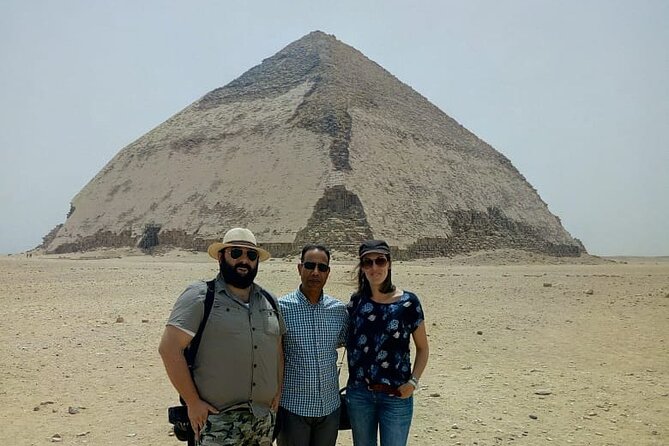
Dahshur lies about 10 kilometers south of Saqqara. The pyramid field is known for early attempts to create the smooth-sided pyramid form that later became familiar at Giza.
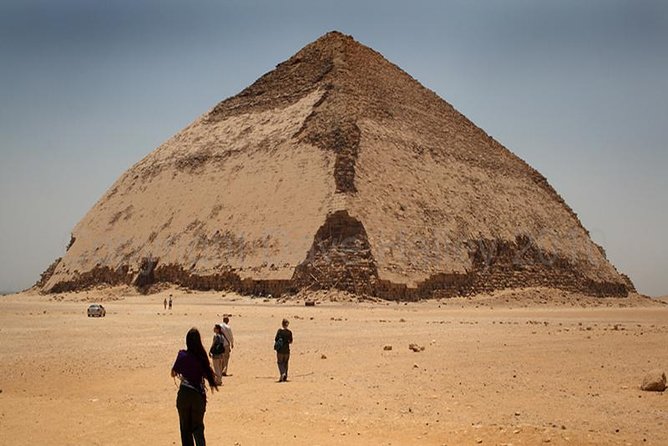
The Bent Pyramid is especially useful for understanding that process. Its lower section has a steep angle, while the upper part changes direction. The shape makes the building problem visible. Ancient engineers were working out how to raise a large stone monument while keeping its structure stable.
The Red Pyramid offers another important step in the same story. Its shape is more consistent, and it is often treated as one of the earliest successful true pyramids. The supplied tour information describes Dahshur as home to the world’s oldest pyramids, but the practical value for you is simpler: this is where you can see early pyramid design in a less crowded setting.
Plan for roughly two hours at Dahshur. The open setting can feel peaceful, but there is less around you than at Giza. Bring a hat, water, and shoes suited to uneven ground. Bottled water and snacks are included, but you should not expect a full meal.
The admission charge is separate. Since tickets are not included, ask the company in advance which entrances are planned for your visit and what they cost. This is especially useful if you want to enter a pyramid rather than view it from outside.
Saqqara and King Djoser’s Step Pyramid
From Dahshur, the vehicle continues to Saqqara. The visit focuses on the complex of King Djoser and his Step Pyramid, described as Egypt’s first pyramid and the first rock-cut building in history.
The Step Pyramid does not have the smooth sides of the later pyramids. It rises in a series of levels, showing how a more traditional royal tomb developed into a much larger monument. This is the place where the guide’s explanation can make a real difference. Without context, the structure may look like a stack of stone terraces. With a clear explanation, you can see it as a turning point in monumental architecture.
The tour allows about two hours here. That is enough time to examine the main complex at a steady pace, ask about Djoser, and take in the scale of the site without forcing every stop into a quick photo break.
Adel is praised for allowing time to explore without rushing and for tailoring explanations to particular interests. Dr. Youssef is described as a leading Egyptologist who served as director of Dahshur excavations. Those details matter because Saqqara rewards questions. You can ask about construction, royal burial customs, religious ideas, or the relationship between Saqqara and Memphis.
The site is not presented as a quick replacement for Giza. It is valuable for a different reason. Saqqara helps you understand the beginning of pyramid construction, not just its most famous finished form.
Memphis, the capital behind the monuments
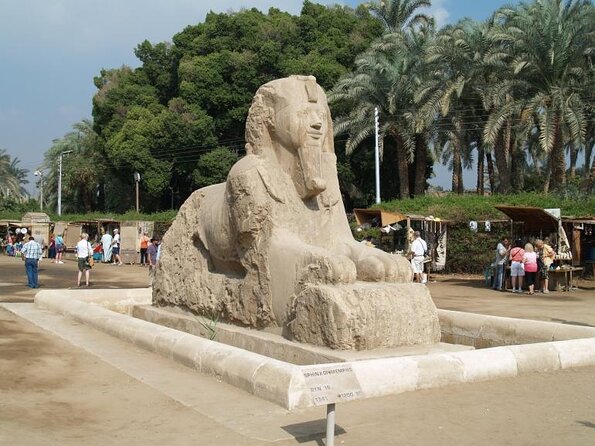
The final major stop is Memphis, one of ancient Egypt’s capitals until around 2,200 BC. It was also a cult center for Ptah, the god associated with creation and craftsmanship.
Memphis changes the feel of the day. Dahshur and Saqqara are mainly connected with royal tombs and monumental building. Memphis brings you into the world of temples, religious practice, administration, and daily political power.
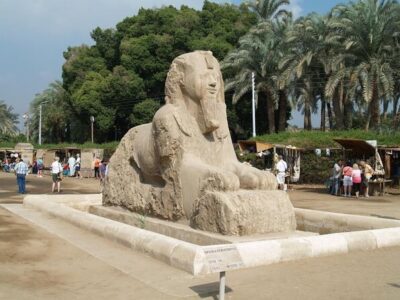
You can expect to see temples and monuments dedicated to Ptah. The surviving remains are not presented as a complete ancient city. Instead, the visit helps you understand why the pyramid fields were built where they were. Royal burial grounds and the capital belonged to the same political and religious system.
The itinerary gives Memphis roughly two hours, though the exact division of time can vary. A private tour is helpful here because you can ask the guide to connect the monuments with the earlier pyramid sites. Adel, who is also identified as the company owner, has been involved with restoration work at some of the sites. That sort of background may add useful detail, though your exact guide is assigned by the operator.
Memphis is also a good final stop because it is less visually overwhelming than a pyramid field. After several hours of monuments, you get a chance to focus on individual statues, temple remains, and the role of Ptah without trying to cover another enormous complex.
A different kind of day out, same part of Egypt:
- Pyramids of Giza: 1-Hour Quad Bike Desert Safari
★ 4.5 · 930 reviews - VIP Giza Pyramids,Sphinx,ATV bike,CamelRide,Shopping&DinnerCruise
★ 5.0 · 704 reviews - From Hurghada: Pyramids and Egyptian Museum Tour & Boat Ride
★ 4.4 · 381 reviews - Egyptian Museum in Cairo: Private Guided Tour
★ 5.0 · 316 reviews
What the private format changes
The tour uses a private vehicle, with pickup and return to your hotel. You are not being moved as part of a large coach group, and only your own party participates.
That gives you several practical advantages. You can ask for more explanation at a site that interests you, spend less time on one that does not, and discuss photography or walking needs with the guide. Solo visitors can also benefit. One person reported being the only participant on the day, which allowed plenty of questions and made the cost feel especially worthwhile.
The group size can vary because the tour offers group discounts, but the activity itself remains private. If you are booking for several people, check how the per-person price changes. A group of friends or family members can get good value from having a dedicated vehicle and guide.
The driver is separate from the Egyptologist guide in at least some arrangements. One French-language account specifically praised both the guide and the driving. Still, pickup communication deserves attention. One visitor experienced a 30-minute delay and suspected a chain of miscommunication. Most other accounts describe pickup as smooth and punctual, but I would confirm your hotel name, pickup time, and a contact number through WhatsApp before the morning begins.
Is $65 good value?
At $65 per person, this is a reasonable price for a private six-hour outing, especially if you are sharing the vehicle with family or friends. The package includes transport, hotel pickup and drop-off, a qualified Egyptologist guide, fuel, facility fees, landing fees, taxes, bottled water, and snacks.
The important catch is that admission tickets are not included. Food and drinks are also listed as excluded, although bottled water and snacks are included. Read that as no full meal or extra refreshments. Budget separately for entry fees and lunch if you need one.
The price makes the most sense if you value explanation and convenience. Hiring transport alone may seem cheaper, but it does not give you the same built-in historical guidance. On the other hand, if you only want quick exterior photographs and already know the sites well, a private guided tour may be more than you need.
The strongest value comes from the access to a specialist guide. Adel is repeatedly described as attentive and flexible. Dr. Youssef’s excavation background is an unusual asset if he leads your visit. Since guide assignment can vary, ask who will accompany you if a particular guide is important to your decision.
Timing, comfort, and what to bring
The stated start time is 8:00 a.m., and the total duration is about six hours. The three stops are each listed at roughly two hours and ten minutes, though driving time and site conditions can affect the schedule.
An early start is sensible. The sites are open and exposed, and mild weather can make the day much easier. One account specifically noted mild weather and low crowds, but conditions will vary by date. You should prepare for sun, dust, and uneven surfaces.
Wear comfortable shoes and bring sun protection. Bottled water and snacks are supplied, but you should carry any additional drink you need. Since the tour does not include a meal, ask about the plan for food before departure.
Most people can participate, according to the supplied information. That does not mean every path is smooth or that all pyramid areas are easy for every mobility level. If you have specific walking concerns, tell the operator when booking so the guide can discuss the practical limits.
The guides are a major part of the experience
The most consistent strength is the guiding. Adel is described as the owner of Egypt Select Tours as well as a guide, and several accounts praise his clear English, patience, and willingness to adapt the day to individual interests.
Abou is also named as a guide, and Dr. Youssef is described as an Egyptologist who directed excavations at Dahshur. These are not interchangeable details. A guide who can explain why the Bent Pyramid changes angle, or how Memphis relates to the pyramid fields, gives the day structure.
You should still treat the guide assignment as something to confirm rather than a guarantee of one specific person. The activity provides a qualified Egyptologist guide, but it does not state that Adel or Dr. Youssef leads every departure.
The best approach is to arrive with a few questions. Ask how the pyramid shapes changed, why Memphis was important, and how Djoser’s complex influenced later Egyptian architecture. A private setting gives you room to go beyond a memorized script.
Who should book this six-hour tour?
I would choose this tour if you have already seen, or plan to skip, the main Giza visit and want a closer look at Egypt’s earlier monuments. It suits first-time visitors who want the big story explained in one day, as well as repeat visitors who prefer quieter archaeological sites.
It is also a good match for solo visitors, couples, families, and small groups who want control over the pace. People with a strong interest in archaeology may value the chance to work through detailed questions with an Egyptologist.
I would think twice if your Cairo schedule is very tight, if you dislike spending most of a day outdoors, or if you want every cost included upfront. The entry fees are extra, and the occasional pickup communication problem means you should confirm the arrangements.
Should you book it?
Book this tour if you want Dahshur, Saqqara, and Memphis in one focused day, with hotel transport and a guide who can explain how the monuments fit together. The combination is stronger than a simple pyramid photo stop, and the private format gives you useful flexibility.
Before paying, confirm the pickup details, ask who the guide will be, and set aside money for admission tickets and food. If those points suit you, $65 is a fair starting price for a personal introduction to some of Egypt’s most important early sites.
FAQ
What time does the tour start?
The stated start time is 8:00 a.m.
How long does the experience last?
The tour lasts approximately six hours.
Does the tour include hotel pickup and drop-off?
Yes. Transport from and back to your hotel is included.
Is the tour private?
Yes. Only your group participates in the private activity.
Are admission tickets included?
No. Admission tickets are not included in the price.
Is food included?
Full food and drinks are not included. Bottled water and snacks are included.
Can I cancel for a full refund?
Yes, if you cancel at least 24 hours before the experience start time. Cancellations made less than 24 hours in advance are not refunded, and changes within that period are not accepted.
Recently reviewed around Giza
- Full Day Trip from Cairo to Luxor★ 5.0 · 16 reviews
- Private half Day Tour to the Great 3 Pyramids of Egypt★ 5.0 · 15 reviews
- Private guide’s trip to Giza pyramids, Great sphinx valley temple★ 5.0 · 37 reviews
- VIP Tour inside Giza Pyramids★ 4.5 · 103 reviews
- Full-Day Private Tour to Giza Pyramids, Sphinx, Memphis & Saqqara★ 5.0 · 106 reviews
- Elite Boats Tour in Cairo & Giza with Drinks Included★ 4.5 · 15 reviews
- Unique Tour to The Grand Egyptian Museum and 12 main galleries★ 4.0 · 38 reviews
- Sakkara, Memphis & Dahshur Tour★ 5.0 · 26 reviews
Memphis & Saqqara Tours, compared.
VIP All inclusive Best of the best Giza Pyramids,Sakkara,Memphis
Read our review →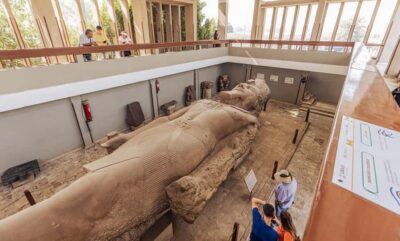
Pyramids of Giza, Sphinx, Saqqara & Memphis Tour
Read our review →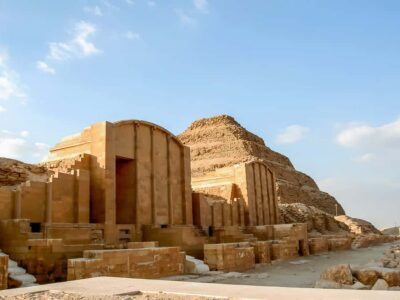
Private Day Tour Giza Pyramids, Sphinx, Memphis, and Saqqara
Read our review →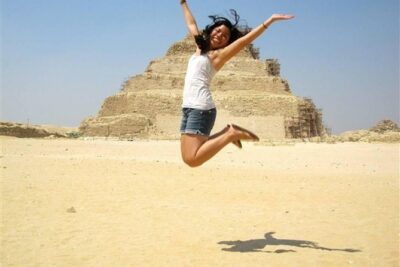
Private tour: GIza Pyramids, Memphis City & Sakkara Pyramid
Read our review →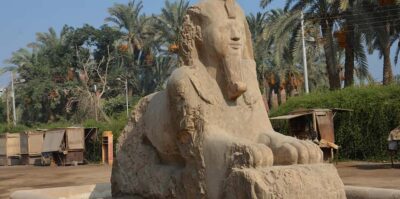
Sakkara, Memphis & Dahshur (Pyramid & Felucca Options)
Read our review →
Private Full-Day Tour to Giza Pyramids,Sphinx,Memphis, and Saqqara
Read our review →
All-inclusive Private Trip Giza Pyramids Sphinx Saqqara, Dahshur
Read our review →Browse the lists this tour appears in