Reviewed · CAIRO TOURS
Overnight Trip To Luxor From Cairo
Luxor is where ancient Egypt comes into focus: painted tombs cut into desert cliffs, giant statues facing the Nile, and temple columns that seem to go on forever. This two-day trip from Cairo covers both banks of the river, giving you a strong first look at the city without arranging flights, trains, hotels, or local transport yourself.
I like the private tour format, since your group travels with its own guide and air-conditioned vehicle. I also like the all-in-one price, which includes domestic flights, hotel, transfers, entry fees, lunch, dinner, and a qualified Egyptologist. The main drawback is the punishing start: pickup is scheduled for 3:30 a.m., and Day 1 packs in several major sites.
In This Review
- Key points to know before booking
- Why this short Luxor trip works
- The 3:30 a.m. start from Cairo
- The Valley of the Kings and the west bank
- Hatshepsut’s temple and the story of a female pharaoh
- The Colossi of Memnon: a quick stop with a big view
- Lunch, then Luxor Temple and Karnak
- Overnight in Luxor
- Medinet Habu and the temple of Ramesses III
- Deir el-Medina and the artisans who built the tombs
- The Valley of the Queens
- What the private format changes
- The $390 question: is the package good value?
- Who should book this Luxor trip?
- FAQ
- How long is the overnight Luxor trip from Cairo?
- What time is pickup on the first day?
- Is the tour private?
- Is transportation included?
- Are admission fees included?
- Are meals included?
- Can Luxor Temple be visited at night?
- Should you book it?
Key points to know before booking
- A 3:30 a.m. Cairo pickup gets you to Luxor by air, but Day 1 will be long and tiring.
- The private guide and vehicle give your group more control than a large coach tour.
- The west bank is the star, with the Valley of the Kings, Hatshepsut, Medinet Habu, Deir el-Medina, and the Valley of the Queens.
- Karnak and Luxor Temple bring the east bank to life, especially if you choose the optional evening visit to Luxor Temple.
- The $390 price covers the costly basics, including flights, accommodation, transfers, meals, guiding, and admission.
- A small airport detail matters: one published account describes being left at the wrong Cairo terminal, so confirm the terminal and pickup instructions carefully.
Why this short Luxor trip works
Luxor is about more than one famous tomb. The old Theban area spreads across both sides of the Nile, and its major monuments each tell a different part of ancient Egyptian life. The west bank is tied to burial and memorial temples. The east bank centers on huge religious complexes built for public worship.
This trip gives you both sides in a tight schedule. You will not have the leisurely pace of a three or four-day Luxor stay, but you will see the sites most people hope to visit. The format also removes much of the planning burden. Your Cairo hotel pickup, airport transfer, Luxor transport, guide, hotel, and return arrangements are bundled together.
The price is $390 per person. That is not a budget day trip, but the comparison is not simply between $390 and a cheaper self-guided visit. You are paying for flights from Cairo, private transfers, one hotel night, a guide, entrance fees, lunch, and dinner. If you value time and want the main work handled for you, the package has solid value.
Other Cairo days travellers weigh against this one:
- Cairo: Pyramids & Great Sphinx Private Tour with Camel Ride
★ 4.9 · 6,335 reviews - Tour to Giza Pyramids and The Egyptian Museum
★ 5.0 · 6,016 reviews - VIP All inclusive Best of the best Giza Pyramids,Sakkara,Memphis
★ 5.0 · 3,164 reviews
The 3:30 a.m. start from Cairo
Your day begins before sunrise, with pickup from your Cairo hotel and transfer to the domestic airport. The early departure is the practical price of seeing Luxor in only two days. Confirm your pickup time, airport terminal, and flight details in advance, especially since one account describes a bad start caused by being taken to the wrong Cairo terminal.
After landing in Luxor, a local representative meets you and the sightseeing begins. This handoff is useful because you do not have to figure out airport transport in an unfamiliar city. From there, the private air-conditioned vehicle carries you between the monuments.
The schedule gives you a guide from the start, and that matters at Luxor. Many temples look like a forest of columns and broken walls until someone explains the symbols, builders, and rituals that shaped them. A guide named Ayman receives especially warm praise in the available feedback, although the guide assigned to your departure may differ.
The Valley of the Kings and the west bank
The Valley of the Kings is the natural headline of Day 1. Pharaohs of the New Kingdom chose this dry valley for their hidden tombs, away from the more exposed pyramid fields. You enter selected tombs cut into the rock and see painted corridors, burial chambers, and scenes meant to help the dead reach the next world.
The tour allows about an hour here. That is enough for an introduction, but not enough to inspect every open tomb at a slow pace. Tomb access can vary, and some special tombs may require an extra ticket, so ask your guide what the included entry covers before you arrive.
The setting is stark and powerful. There are no lush gardens or grand city streets here, just pale hills, stone paths, and tomb entrances tucked into the cliffs. Bring water, wear sensible shoes, and expect heat and glare even when the air feels mild in Cairo.
The tour description says the route includes tombs from various dynasties, along with Deir el-Bahari and Queen Hatshepsut’s temple. These are close enough to combine efficiently, but the order may shift depending on local timing.
Hatshepsut’s temple and the story of a female pharaoh
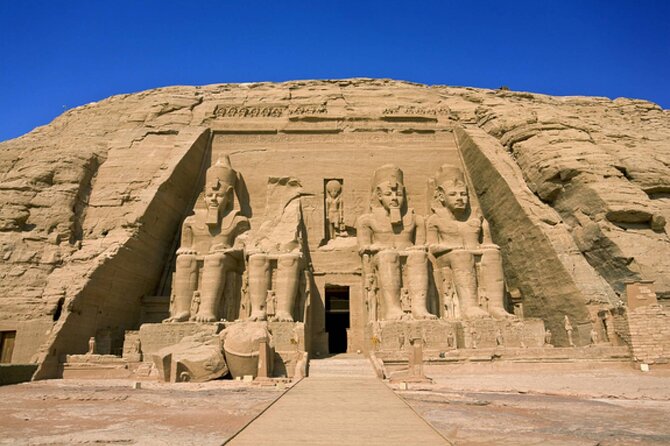
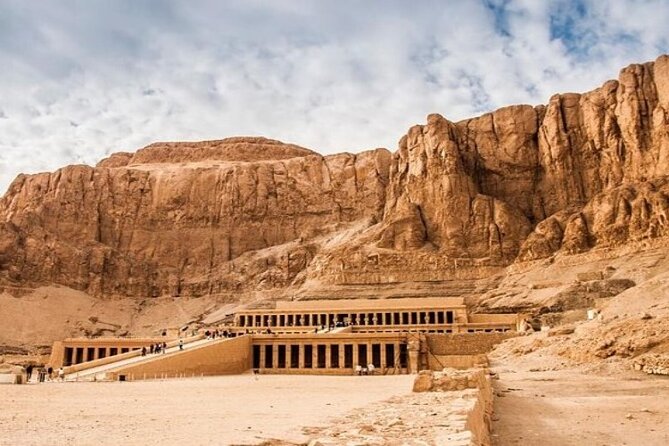
Queen Hatshepsut’s temple sits against the cliffs in a series of broad terraces. Its clean lines differ from the dark, enclosed tombs in the Valley of the Kings, and the contrast makes this stop especially worthwhile.
Hatshepsut ruled as pharaoh during the 18th Dynasty and presented herself in the traditional form of a male king. Your Egyptologist can explain how the temple’s reliefs supported her authority and how later rulers altered parts of her memory.
You should expect a short walk from the vehicle, open sun, and a wide view across the west bank. The temple is primarily an architectural and visual stop, while the Valley of the Kings is more intimate and enclosed. Together, they give you two very different views of royal power.
A different kind of day out, same part of Egypt:
- From Cairo: Pyramids of Giza, Sphinx, Saqqara & Memphis Tour
★ 4.7 · 3,110 reviews - Cairo 8 Hour Private Tour of Pyramids, Egyptian Museum and Bazaar
★ 5.0 · 2,931 reviews - Cairo: Pyramids, Sakkara & Memphis Tour with Lunch
★ 4.6 · 2,493 reviews - Private ViP all-inclusive Giza Pyramids,Sphinx,Inside Pyramid
★ 5.0 · 2,448 reviews
The Colossi of Memnon: a quick stop with a big view
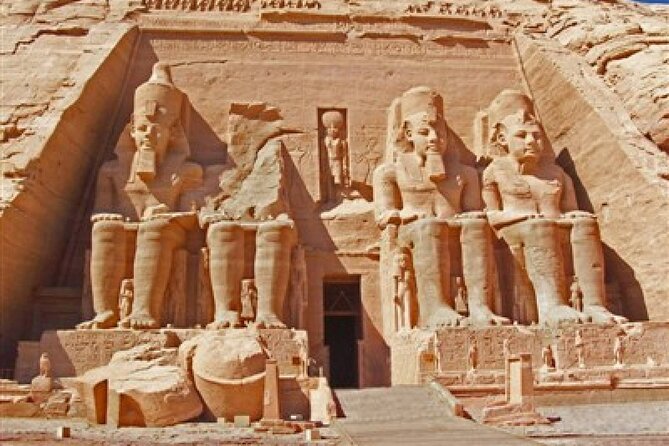
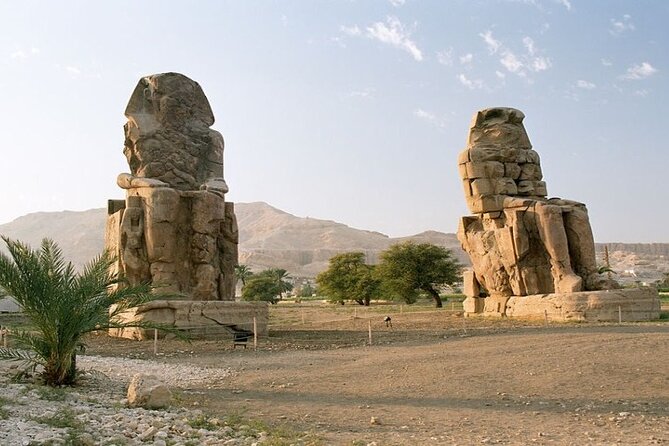
The Colossi of Memnon are two immense seated statues of Amenhotep III, facing toward the Nile. They once guarded the entrance to a vast mortuary temple, most of which has disappeared.
The scheduled visit lasts about an hour, though the actual stop may feel shorter if your guide uses the time for photographs and an explanation. These figures are easy to appreciate quickly. Their size becomes clear only when you stand near their feet and look up.
This is also a useful pause between the larger west bank monuments. You can stretch your legs, take in the open view, and hear how floods, stone reuse, and time changed the area around the statues.
Lunch, then Luxor Temple and Karnak
Lunch is included at a local restaurant, with a full meal for each person. Beverages are not included, so carry Egyptian pounds or another accepted payment method for drinks. The meal break gives you a chance to sit down before the east bank temples, which arrive after a demanding morning.
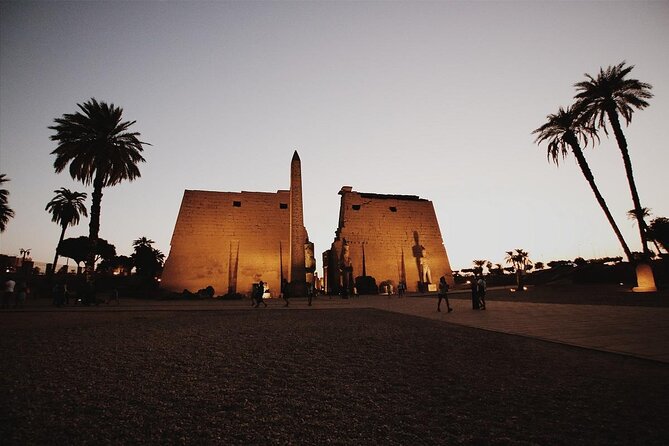
Luxor Temple is a good late-day introduction to the east bank. Its courtyard, colossal statues, and granite figures of Ramses the Great show how temples were designed to impress people approaching from the river and the Avenue of Sphinxes.
The visit is scheduled for about an hour. Ask your guide to point out how later rulers and religions reused the site. Luxor Temple is not only a set of ancient ruins. It is a place where construction continued across different reigns, leaving layers of Egyptian history in one compact area.
Karnak is the larger and more demanding stop. It is a vast group of temples built and altered over many centuries. The route includes the Avenue of Sphinxes, the Unfinished Propylon, the Great Hypostyle Hall with its 134 massive columns, the obelisks of Hatshepsut and Thutmose III, the temple of Amun, the Sacred Lake, and the granite scarab of Amenhotep III.
The Great Hypostyle Hall is the moment many people remember. The columns are so large that the space feels more like a stone forest than a conventional room. Give yourself time to look upward at the carved surfaces, but stay near your guide so you do not lose the thread of the visit.
Karnak can be tiring after the valley tombs and lunch. Wear shoes that can handle uneven surfaces, and do not underestimate the walking. If your group still has energy, Luxor Temple may be visited at night from 6 p.m. to 9 p.m. when requested. Confirm this option before the day begins, since it is listed as a possibility rather than a fixed part of the schedule.
Overnight in Luxor
After the east bank visits, you are transferred to a hotel in Luxor. Dinner is included at the hotel, and you spend the night in the city rather than returning immediately to Cairo.
This overnight is one of the tour’s better choices. A same-day flight trip would leave you exhausted and would make the west and east bank schedule even harsher. The hotel night also gives you a small break between the two sightseeing days.
Do not expect a long free evening. Day 1 starts at 3:30 a.m., and the next pickup is scheduled for 7 a.m. Treat the hotel as a practical rest stop, not as a base for a full night out.
Medinet Habu and the temple of Ramesses III
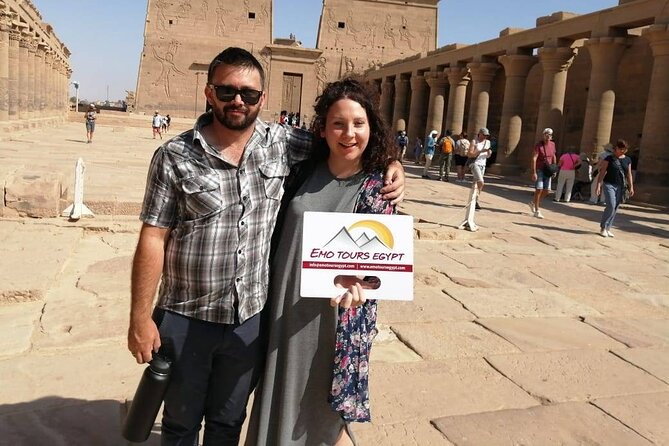
Day 2 begins at 7 a.m. with your guide and private air-conditioned vehicle. The first destination is Medinet Habu on the west bank, near the Theban Hills.
The site is best known for the mortuary temple of Ramesses III, an approximately 150-meter-long complex with a conventional temple plan. Its walls and gateways help show how royal memorial temples worked, and the site often feels more focused than the sprawling Karnak complex.
You also visit the Temple of Amun within the wider Medinet Habu area. The temple began under Hatshepsut and Thutmose III and was altered across later dynasties, including the Greco-Roman period. That long sequence of changes gives your guide plenty to explain, from early royal building to later repairs and additions.
The schedule assigns about an hour to the main temple and another hour to the wider area. That is useful time, but the two entries are presented as separate stops even though they belong to the same archaeological zone. The practical effect is a detailed morning visit without adding another long vehicle transfer.
Deir el-Medina and the artisans who built the tombs
Deir el-Medina, also called the Valley of the Artisans, gives you a different angle on ancient Egypt. This was the village of workers who made and decorated the royal tombs from roughly 1550 to 1080 BC.
The site is scheduled for 30 minutes, so this is a compact visit. Its importance is not size but subject matter. Instead of seeing only royal monuments, you get a glimpse of the community behind them: the artisans, their homes, and the work that produced the painted tomb interiors.
The paintings are noted for looking remarkably fresh. Take time to notice the color and detail, but keep your expectations realistic. Half an hour is enough for a first look, not a slow study of every room and inscription.
The Valley of the Queens
The final major stop is the Valley of the Queens, known in ancient times as Ta-Set-Neferu, or the place of the children of the pharaoh. Queens, princes, princesses, and some members of the nobility were buried here during the 18th, 19th, and 20th Dynasties.
The valley was chosen for its isolation in the western hills and its closeness to Thebes. Mortuary priests cared for the tombs and carried out rituals and offerings for the dead. Those details make this stop more than a second version of the Valley of the Kings.
You have about an hour here. As with the other burial valleys, available tombs and entry rules can change, so ask what is included. The site is a fitting end to the tour because it broadens the story beyond male rulers and monumental temples.
What the private format changes
The private setup is a real advantage if you want to ask questions or adjust the pace. Only your group participates, and transport is by private, late-model air-conditioned vehicle. That means you are not waiting for a large bus to load or trying to hear a guide over a crowd.
Private does not mean slow. The itinerary remains tightly packed, and the guide must keep the group moving to fit the flight schedule and the many monuments. Still, you can usually pause for a question, spend a little longer at a favorite relief, or request the possible evening visit to Luxor Temple.
The included Egyptologist guide is central to the value. Without interpretation, Karnak can feel overwhelming and the tomb paintings can blur together. With a good guide, the sites connect: royal burial, temple ritual, political power, and the daily work of the people who built it all.
The $390 question: is the package good value?
For $390 per person, you receive:
- Domestic flights between Cairo and Luxor
- One hotel night in Luxor
- Private air-conditioned transfers
- Hotel, port, or airport pickup and drop-off
- A private tour guide
- Entrance fees
- Lunch at a local restaurant
- Dinner at the hotel
That bundle makes the price easier to justify. Flights alone can make a short Cairo to Luxor trip costly, and arranging separate airport transfers, a guide, tickets, transport, and a hotel can take time and create room for mistakes.
The package is less attractive if you already have a hotel in Luxor, prefer trains, or want to choose every site independently. It is also not designed for travelers who want long afternoons beside the Nile or unplanned time in town. You are buying efficiency and convenience, not a relaxed Luxor holiday.
Group discounts may be available, which could improve the price for families or larger parties. Tipping and personal items are not included, and drinks at lunch cost extra. Keep those small costs in your budget.
Who should book this Luxor trip?
I would point this tour toward a first-time Egypt visitor based in Cairo who has only two days for Luxor. It suits you if you want the major monuments, prefer a private guide, and do not want to manage domestic flights and local transport.
It also works well for couples, families, and small groups who want to stay together. Most people can participate, and the private arrangement avoids the social pace of a large group. You should still be ready for early mornings, substantial walking, heat, uneven ground, and a full sightseeing schedule.
I would hesitate to recommend it to anyone who dislikes rushed touring or has mobility needs that require detailed site-by-site confirmation. The supplied information says most travelers can participate, but it does not provide specific accessibility details for tombs, temple paths, or vehicles.
FAQ
How long is the overnight Luxor trip from Cairo?
The experience lasts approximately two days, including one overnight stay in a Luxor hotel.
What time is pickup on the first day?
Pickup from your Cairo hotel is scheduled for 3:30 a.m., followed by transfer to the domestic airport for the flight to Luxor.
Is the tour private?
Yes. This is a private activity, and only your group participates.
Is transportation included?
Yes. The package includes airport, hotel, and other transfers by private air-conditioned vehicle, along with pickup and drop-off.
Are admission fees included?
Yes. Entry fees for the listed historic sites are included in the package.
Are meals included?
Lunch at a local restaurant and dinner at the Luxor hotel are included. Beverages are not included with lunch.
Can Luxor Temple be visited at night?
A night visit to Luxor Temple may be possible from 6 p.m. to 9 p.m. if you request it. It is listed as an option, not a guaranteed part of every departure.
Should you book it?
Book this trip if you want a fast, well-organized introduction to Luxor and value having flights, transport, guiding, tickets, and lodging handled in one purchase. The strongest parts are the private Egyptologist guide, the full west and east bank coverage, and the chance to see less commonly visited places such as Deir el-Medina and Medinet Habu.
Think twice if you need a relaxed pace or want to explore Luxor independently. Confirm your Cairo airport terminal, ask which tombs and entry fees are covered, and request the possible Luxor Temple night visit before departure. With those details settled, the $390 package offers a practical way to reach Egypt’s greatest concentration of ancient monuments in only two demanding but rewarding days.
Recently reviewed around Cairo
- White Desert Overnight Camping Sharing Tour in Egypt★ 5.0 · 15 reviews
- Cairo Best 2Days tour Pyramids, Saqqara & Old Cairo★ 5.0 · 15 reviews
- Giza Pyramids with (GEM) Grand Egyptian Museum★ 5.0 · 42 reviews
- sunset at Giza pyramids by camels★ 5.0 · 31 reviews
- Tour to Giza pyramids Memphis Sakkara and Felucca on the Nile★ 5.0 · 16 reviews
- visit the pyramids of Giza + the necropolis of Saqqara + the Memphis site.★ 4.5 · 20 reviews
- Private Giza pyramid,sphinx, Mummification temple& inside pyramid★ 5.0 · 32 reviews
- Private guided shopping tour in Khan el-Khalili with Lunch★ 4.5 · 21 reviews
Cairo Tours, compared.
Pyramids & Great Sphinx Private Tour with Camel Ride
Read our review →
Tour to Giza Pyramids and The Egyptian Museum
Read our review →
VIP All inclusive Best of the best Giza Pyramids,Sakkara,Memphis
Read our review →
Pyramids of Giza, Sphinx, Saqqara & Memphis Tour
Read our review →
Cairo 8 Hour Private Tour of Pyramids, Egyptian Museum and Bazaar
Read our review →
Private ViP all-inclusive Giza Pyramids,Sphinx,Inside Pyramid
Read our review →