Reviewed · CAIRO TOURS
Private Full-Day Red Sea Monasteries Tour from Cairo
The best part of this day is the sharp change of scene. You leave Cairo’s traffic behind and cross the Eastern Desert toward the Red Sea Mountains, where two ancient Coptic monasteries sit far from the usual sightseeing circuit. St. Anthony’s and St. Paul’s offer a quieter, more personal look at Egypt’s Christian past.
I like the private minivan, since a long day on the road is easier when you travel with only your own group. I also like the freedom to explore both compounds independently, from St. Anthony’s painted churches and library to St. Paul’s cave church, fortress, and old monastery buildings. The drawback is simple: expect about three hours each way, so this is a full road day rather than a relaxed local outing.
In This Review
- Key points to know before booking
- Why these Red Sea monasteries are worth the long ride
- The three-hour journey from Cairo to the Red Sea Mountains
- St. Anthony’s Monastery, a working desert retreat
- St. Paul’s Monastery and the cave at its center
- Lunch in Zafarana after the monastery visits
- What the private format changes
- Practical details that can make the day easier
- Who should book this Red Sea monasteries tour
- Should you book it?
- FAQ
- How long is the Red Sea monasteries tour?
- Where does hotel pickup take place?
- Which monasteries are included?
- How long do you spend at each monastery?
- Is lunch included?
- Are drinks included with lunch?
- Is a vegetarian meal available?
- Can you cancel for a full refund?
Key points to know before booking
- Two of the world’s oldest monasteries: Visit St. Anthony’s, founded in the 4th century, and St. Paul’s, founded in the 5th century.
- A long but rewarding drive: The route from Cairo takes roughly three hours each way through the Eastern Desert.
- Private touring: Your group travels by air-conditioned minivan with hotel pickup and drop-off in Cairo or Giza.
- Independent exploration: You have free time to see churches, gardens, towers, libraries, frescoes, icons, and manuscripts at your own pace.
- A spiritual setting: St. Anthony’s and St. Paul’s remain working Coptic monasteries, not simply museum sites.
- Lunch included: A meal in Zafarana follows the monastery visits, but drinks cost extra.
Why these Red Sea monasteries are worth the long ride
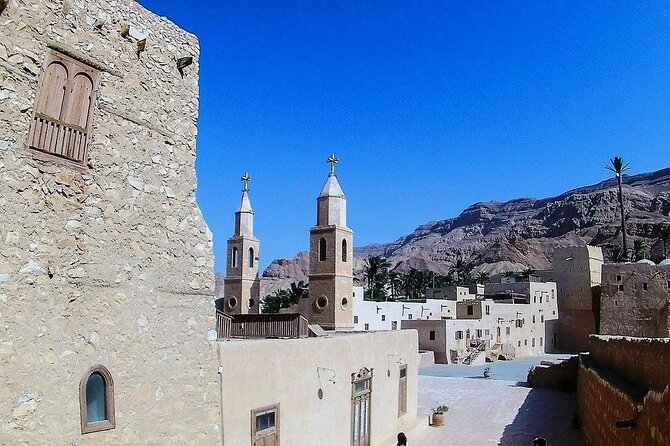
Cairo gives you pharaohs, mosques, markets, and museums. This tour gives you a different Egypt, one shaped by desert solitude and early Christian monastic life. The monasteries were founded around hermits who lived in caves in the Red Sea Mountains, and their buildings still reflect that connection between rough mountain country and religious retreat.
You will spend about ten hours on the road and at the sites, with a start around 7:00 am. That early departure matters. It gives you the best chance of completing both monastery visits without turning the return to Cairo into an even later night.
The $175 price per person needs to be judged against what it covers. You are paying for private transport, a driver-guide, hotel pickup and drop-off, entrance fees, and lunch. For a solo visitor or couple, it is not a budget excursion. For a small group, though, the private format and included transport make the cost easier to justify, especially since arranging a visit to these remote sites independently would be less straightforward.
The tour is also useful if you want more control than a standard group bus provides. You can ask questions, pause for photographs, and spend more time in the church or garden that interests you most. The tradeoff is that the commentary depends on the driver-guide assigned to your departure. Guides connected with this experience include Ali and Andrew, and Sayid has been named as a driver. Andrew is described as speaking very good English, while Ali is noted for offering helpful explanations about Egypt and the monasteries.
More Cairo trips worth a second look
- From Cairo: Private Full-Day Tour of Historical Alexandria
★ 4.1 · 1,155 reviews - Old Cairo: Full-Day Islamic and Coptic Cairo Tour with Lunch
★ 4.6 · 688 reviews - Private Full-Day Tour to Giza Pyramids,Sphinx,Memphis, and Saqqara
★ 5.0 · 626 reviews
The three-hour journey from Cairo to the Red Sea Mountains
Pickup begins at your Cairo or Giza hotel. From there, you travel east in a private, air-conditioned minivan with your driver-guide. The route passes through Egypt’s Eastern Desert, with the city gradually giving way to open desert and the craggy Red Sea Mountains.
This is not a quick transfer between nearby attractions. Allow roughly three hours for the outbound drive, followed by the monastery visits, lunch, and the return journey. Bring patience, a phone or camera, and something to occupy you during the quieter stretches of road.
The drive is part of the experience because it shows how remote these monasteries are. Their location was not chosen for easy access. Early hermits sought silence, distance, and protection from ordinary life. You can understand that purpose better once Cairo has disappeared behind you and the mountains begin to frame the route.
Your guide can provide background during the journey. This is especially helpful because the two sites are linked by early Coptic Christianity but have different stories. St. Anthony was a hermit whose followers established the monastery connected with his cave. St. Paul lived in a cave as well, and the monastery grew around that place.
St. Anthony’s Monastery, a working desert retreat
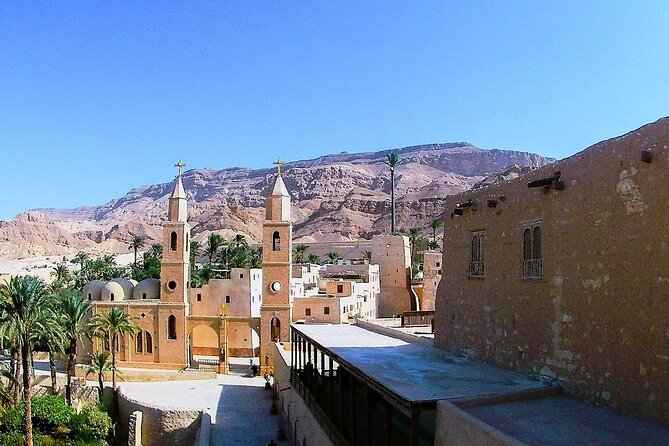
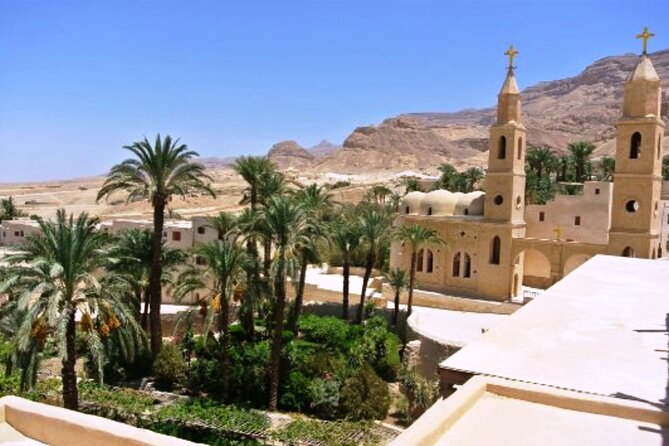
The first major stop is St. Anthony’s Monastery, also known as Deir Mar Antonios. It lies in an oasis in the Eastern Desert, in the southern part of the Suez Governorate, about 334 kilometers southeast of Cairo. It is described as the oldest monastery in the world and is still a working Coptic Christian community.
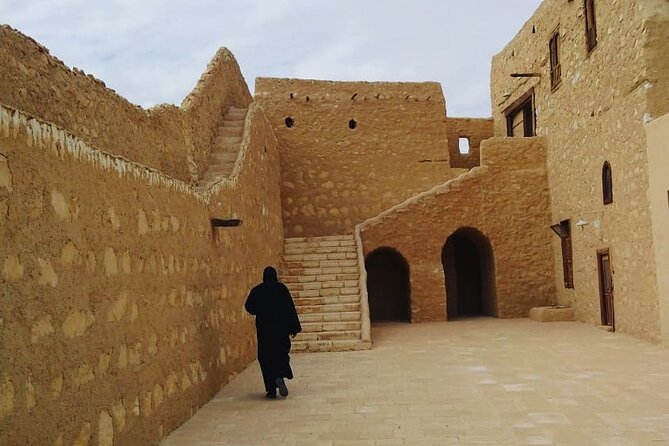
You enter through the walled complex and have about two hours to explore. The experience is not built around a single grand monument. Instead, you move among churches, gardens, religious buildings, and other parts of the compound, seeing how the monastery functions as both a historic site and a living retreat.
Inside, look for wall paintings of holy knights and hermits dating from the 7th and 8th centuries. These frescoes are among the most important details of the visit. They show the age of the place in a direct way, with painted figures and worn surfaces that feel very different from the polished presentation of a modern museum.
The churches and library add another layer. You may see icons and manuscripts, along with the religious art and objects preserved by the monastery. The details can be easy to miss if you rush, so use the independent time well. Ask your guide about the buildings first, then take a quiet walk through the areas open to you.
The gardens are another pleasant surprise in such a dry setting. You can stroll among them and see working monks going about daily life. This is one reason the stop feels more substantial than a quick photo visit. You are not only looking at old walls. You are seeing a place that continues to serve its original religious purpose.
There is also an optional climb to St. Anthony’s cave, high in the mountains. The supplied details do not give a duration, difficulty level, or access conditions, so ask your guide before setting out. Do not treat it as an automatic part of the two-hour visit. The main monastery itself offers plenty to see, and the cave climb may not suit every member of your group.
St. Paul’s Monastery and the cave at its center
The route then continues through the hills to St. Paul’s Monastery, also called Deir Anba Bola. This site began as a group of hermitages near the cave where St. Paul lived. Its most distinctive feature is the Church of St. Paul, built in and around that cave.
You again have about two hours for independent exploration. The church is described as compact and full of visual details: altars, candles, ostrich eggs, and murals showing saints and scenes from the Bible. The ostrich eggs symbolize the Resurrection, giving you one small but memorable detail to look for inside.
The underground church incorporates St. Paul’s cave and burial place. That arrangement makes the visit feel intimate. Instead of seeing a large church built apart from the saint’s retreat, you see religious architecture wrapped around the rough place where he lived.
The story of St. Paul is central here. According to the monastery tradition, a raven fed him bread during his years in the cave. Your guide can help connect this story with the paintings, icons, and other objects inside the churches.
Do not skip the refectory, mill, and tower. They show the practical side of monastic life, not only its devotional side. The fortress above the church was used as a refuge when monks faced Bedouin raids. Together, the tower and fortress help explain how isolated communities protected themselves in a remote part of the desert.
St. Paul’s is smaller in feel than many famous Egyptian monuments, and that is part of its appeal. You will not be moving through a huge archaeological complex with crowds and long routes between buildings. Instead, the interest comes from the cave church, the old defensive structures, and the concentration of paintings and religious objects.
A different kind of day out, same part of Egypt:
- Cairo: Pyramids & Great Sphinx Private Tour with Camel Ride
★ 4.9 · 6,335 reviews - Tour to Giza Pyramids and The Egyptian Museum
★ 5.0 · 6,016 reviews - VIP All inclusive Best of the best Giza Pyramids,Sakkara,Memphis
★ 5.0 · 3,164 reviews - From Cairo: Pyramids of Giza, Sphinx, Saqqara & Memphis Tour
★ 4.7 · 3,110 reviews
Lunch in Zafarana after the monastery visits
After both monastery visits, the tour stops in Zafarana for lunch at a local restaurant. The meal is included, which is useful after a morning spent on the road and walking around the compounds.
Drinks are not included, so plan to pay separately for them. A vegetarian option is available, but you need to request it when booking. That small step matters because lunch is taken at a local restaurant rather than described as a flexible food stop with many choices.
The timing also makes sense. Eating after the monasteries lets you finish the main sightseeing before settling in for the return drive. After lunch, you can relax in the air-conditioned minivan while heading back to your hotel in Cairo or Giza.
What the private format changes
This is a private tour, so only your own group participates. That makes the day more adaptable than a shared coach excursion. If one person wants to spend extra time looking at frescoes or manuscripts, your group can discuss the pace with the driver-guide rather than follow a large crowd.
The private setup also helps with the long journey. You can settle into the minivan with your own companions, rather than spend the day meeting pickup schedules for many unrelated groups. Hotel pickup and drop-off remove the need to find your way to a distant departure point at 7:00 am.
Still, private does not mean fast. The monasteries are remote, and the travel time remains the same. You should book this for the unusual destinations, not because you expect a short or effortless day.
The vehicle is air-conditioned, an important feature for a desert route. The tour information does not specify the exact minivan model, seating arrangement, or luggage capacity, so ask the provider if those points matter to you.
Practical details that can make the day easier
Wear smart-casual clothing, as requested for the experience. These are active religious sites, so modest, respectful clothing is the sensible choice even though the stated dress code is not highly formal.
You will be walking through churches, gardens, and monastery grounds for about two hours at each main stop. Comfortable shoes are a good idea. If you are considering the climb to St. Anthony’s cave, ask about the route before committing.
Most people can participate, and the tour is near public transportation, although the included hotel pickup is the more practical choice for this early start. The tour can operate with a multilingual guide, so confirm your preferred language when booking if that is important to you.
Bring money for drinks and any personal purchases. Entrance fees are included, as are lunch and transport. Confirmation is provided at booking, and cancellation is free up to 24 hours before the start time. Changes or cancellations inside that 24-hour window are not accepted for a refund.
Who should book this Red Sea monasteries tour
I would recommend this day to anyone who has already seen Cairo’s main sights and wants a more unusual side of Egypt. It suits visitors interested in Coptic Christianity, desert history, religious art, and places that still operate as communities rather than preserved ruins.
It is also a good match for small groups who value privacy. Families, couples, and friends can share the cost of the vehicle while keeping control over the pace. The included lunch and hotel service simplify a day that would otherwise require more planning.
I would think twice if your Cairo schedule is very tight or if long drives quickly wear you down. Ten hours is a serious commitment, and the monasteries cannot be reached with a short city transfer. You should also be realistic about the optional cave climb, since no exact time or difficulty is provided.
The tour earns its strongest praise for the guide and driver service. Ali is described as friendly and helpful, while Andrew and Sayid are described as professional, patient, attentive, and supportive. Those qualities matter here because a good guide can turn a long drive and two complex religious sites into a clear, manageable day.
Should you book it?
Book this tour if you want to see St. Anthony’s and St. Paul’s in one private day and you are willing to spend much of the day on the road. The combination of ancient cave churches, desert mountains, frescoes, gardens, and working monastic life is unusual, and the private vehicle gives you welcome breathing room.
Skip it if your priority is a quick excursion from Cairo or if you prefer famous monuments with short transfer times. At $175 per person, the value is strongest for a small group that will use the included transport, guide, lunch, and hotel service. For the right traveler, this is one of the most distinctive full-day trips you can make from Cairo.
FAQ
How long is the Red Sea monasteries tour?
The tour lasts approximately 10 hours, beginning at about 7:00 am.
Where does hotel pickup take place?
Pickup and drop-off are offered at hotels in Cairo or Giza.
Which monasteries are included?
The tour visits St. Anthony’s Monastery and St. Paul’s Monastery, two ancient Coptic Christian monastic retreats.
How long do you spend at each monastery?
The planned visit is about two hours at St. Anthony’s and two hours at St. Paul’s.
Is lunch included?
Yes. Lunch at a local restaurant in Zafarana is included after the monastery visits.
Are drinks included with lunch?
No. Drinks are not included and must be paid for separately.
Is a vegetarian meal available?
Yes. A vegetarian option is available if you advise the provider when booking.
Can you cancel for a full refund?
Yes. You can cancel at least 24 hours before the experience start time for a full refund. Changes or cancellations made less than 24 hours before departure are not accepted.
Recently reviewed around Cairo
- White Desert Overnight Camping Sharing Tour in Egypt★ 5.0 · 15 reviews
- Cairo Best 2Days tour Pyramids, Saqqara & Old Cairo★ 5.0 · 15 reviews
- Giza Pyramids with (GEM) Grand Egyptian Museum★ 5.0 · 42 reviews
- sunset at Giza pyramids by camels★ 5.0 · 31 reviews
- Tour to Giza pyramids Memphis Sakkara and Felucca on the Nile★ 5.0 · 16 reviews
- visit the pyramids of Giza + the necropolis of Saqqara + the Memphis site.★ 4.5 · 20 reviews
- Private Giza pyramid,sphinx, Mummification temple& inside pyramid★ 5.0 · 32 reviews
- Private guided shopping tour in Khan el-Khalili with Lunch★ 4.5 · 21 reviews
Cairo Tours, compared.
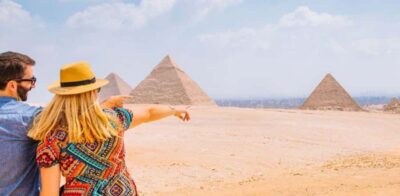
Pyramids & Great Sphinx Private Tour with Camel Ride
Read our review →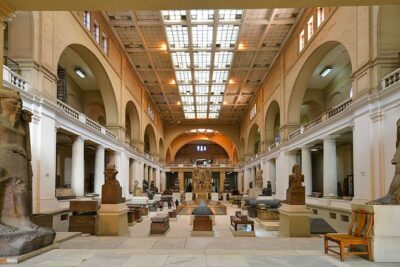
Tour to Giza Pyramids and The Egyptian Museum
Read our review →
VIP All inclusive Best of the best Giza Pyramids,Sakkara,Memphis
Read our review →
Pyramids of Giza, Sphinx, Saqqara & Memphis Tour
Read our review →
Cairo 8 Hour Private Tour of Pyramids, Egyptian Museum and Bazaar
Read our review →
Private ViP all-inclusive Giza Pyramids,Sphinx,Inside Pyramid
Read our review →