Reviewed · CAIRO TOURS
Private Tour 3-Days in Cairo, Giza & Luxor
Egypt’s greatest sights are spread across a wide area, and this tour tackles them in three packed days. You’ll see the Red and Bent Pyramids at Dahshur, the Step Pyramid at Saqqara, the Giza pyramids, Cairo’s old religious quarter, and the major temples and tombs of Luxor.
I like the private format and the Egyptologist guide, since you can ask questions, set the pace within reason, and get help making sense of places that can otherwise blur together. I also like that flights to Luxor and lunch each day are included, removing two common planning chores.
The drawback is the schedule. Day 1 and Day 2 each run through several major sites, while Day 3 is a roughly 12-hour Cairo to Luxor flight excursion. You’ll see a great deal, but this is sightseeing at full speed, not a restful holiday.
In This Review
- Key things to know before booking
- Why starting at Dahshur makes sense
- Saqqara and the earliest stone monument
- Giza, the Sphinx, and the Valley Temple
- The Egyptian Museum and Cairo’s older faiths
- Saladin’s Citadel and Mohammed Ali Mosque
- Khan Al-Khalili after the monuments
- Flying to Luxor for a full day of temples and tombs
- What the $1,000 price really covers
- How the guides shape the experience
- Who should book this three-day plan?
- Should you book it?
- FAQ
- How long is the tour?
- What time does the tour start?
- Is the tour private?
- Is hotel pickup included?
- Is accommodation included?
- Is the Luxor flight included?
- Are meals included?
- Which pyramids are visited?
- What does the Luxor day include?
- Can I cancel for a full refund?
Key things to know before booking
- Dahshur comes before Giza: You begin with the Red Pyramid and Bent Pyramid, seeing an earlier stage in pyramid design before reaching Egypt’s most famous monuments.
- Saqqara rewards a guide: The Step Pyramid, pyramid texts, causeway, and decorated tombs make this more than a quick photo stop.
- Cairo’s second day changes the subject: The Egyptian Museum, Coptic Cairo, Saladin’s Citadel, and Khan Al-Khalili show Egypt beyond the pharaohs.
- Luxor is a very long day: A flight makes the distance practical, but the 12-hour schedule requires an early start and plenty of energy.
- Guiding is a major part of the experience: Guides associated with the company include Hala, also called Sugar Queen, Muhammad, Muhammad Raki, Dr. Mo, and Mark. Your assigned guide may vary.
- The price covers more than transport: At $1,000 per person, the package includes entrance fees, private transport, guide services, snacks, three lunches, and Luxor flights, but not accommodation.
Why starting at Dahshur makes sense
Most first-time Cairo visits rush straight to Giza. I like that this tour starts farther south at Dahshur, where the monuments show how Egyptian builders worked toward the classic pyramid shape.
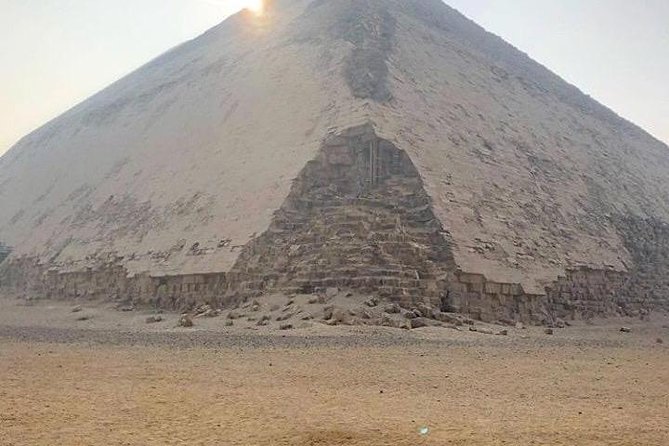
The Red Pyramid is described as the first true pyramid, while the Bent Pyramid records an earlier attempt to solve the same engineering problem. Both are linked to King Snefru, father of Khufu and founder of the Fourth Dynasty, around 2620 BC.
The Bent Pyramid is especially interesting because of its unusual change in angle. Restoration work kept it closed for many years, and it reopened to visitors in 2019. That makes it a useful stop for understanding pyramid development rather than simply looking at three famous triangles from a distance.
You have about two hours here, with admission included. That is enough time to hear the explanation, look closely at the structures, and explore with your guide. If entering a pyramid matters to you, confirm exactly which interior access is available on your date, since the information supplied does not specify every interior ticket or access arrangement.
Dahshur is also a calmer beginning than Giza. You can start with the historical story before facing the crowds, traffic, and spectacle of the main pyramid site.
More Cairo trips worth a second look
- Cairo: Pyramids & Great Sphinx Private Tour with Camel Ride
★ 4.9 · 6,335 reviews - Cairo 8 Hour Private Tour of Pyramids, Egyptian Museum and Bazaar
★ 5.0 · 2,931 reviews - Private ViP all-inclusive Giza Pyramids,Sphinx,Inside Pyramid
★ 5.0 · 2,448 reviews
Saqqara and the earliest stone monument
Saqqara follows with another two-hour visit. The centerpiece is the Step Pyramid complex of King Djoser, often spelled Zoser in tour materials. It is presented as the oldest complete building made of stone, and its stepped design marks a major point in the development of Egyptian monumental construction.
The stop is not limited to the Step Pyramid. You’ll hear about the Pyramid of Unas, described as the first pyramid with pyramid texts inside, and see the causeway of Unas, the Pyramid of Userkaf, and the Pyramid of Teti. Teti’s pyramid is accessible with its own pyramid texts, giving you a chance to connect the carved inscriptions with the beliefs of the period.
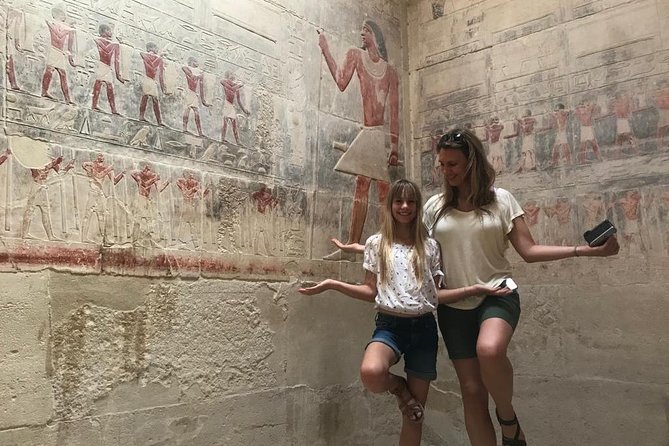
The tomb of Kagemni adds a different scale. Instead of a royal pyramid, you see the burial place of an Old Kingdom nobleman from around 2200 BC. Tombs such as this help explain daily life, work, food, animals, and social rank in ways that a royal monument alone cannot.
This is where a strong guide makes a real difference. Hala has been praised for explaining difficult subjects in clear terms, sometimes using drawings to make the layout and history easier to follow. Other guides connected with the company include Dr. Mo and Muhammad Raki, who are noted for combining ancient Egyptian history with discussion of later Egyptian culture.
Giza, the Sphinx, and the Valley Temple
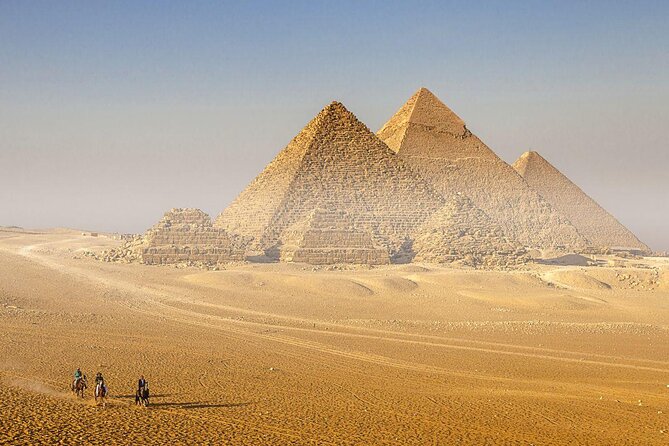
After Dahshur and Saqqara, the tour reaches the Giza plateau. You’ll see the pyramids of Cheops, Chephren, and Mycerinus, using both their Greek names and their Egyptian historical context.
The Great Pyramid of Cheops is the largest and most famous. Chephren’s pyramid often appears taller because it sits on higher ground and retains some of its original casing near the top. Mycerinus is smaller, but it completes the royal group and helps show that the plateau was planned as a group of monuments rather than a single isolated building.
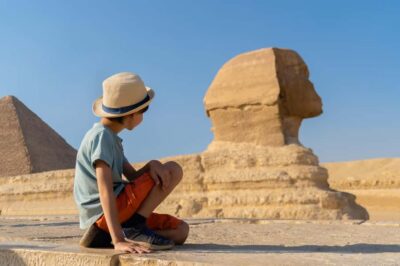
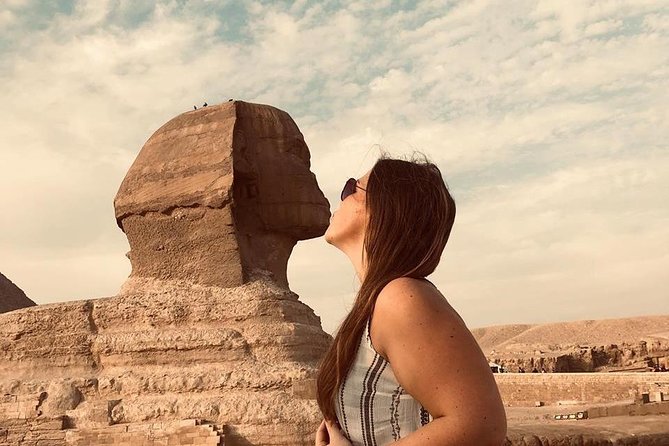
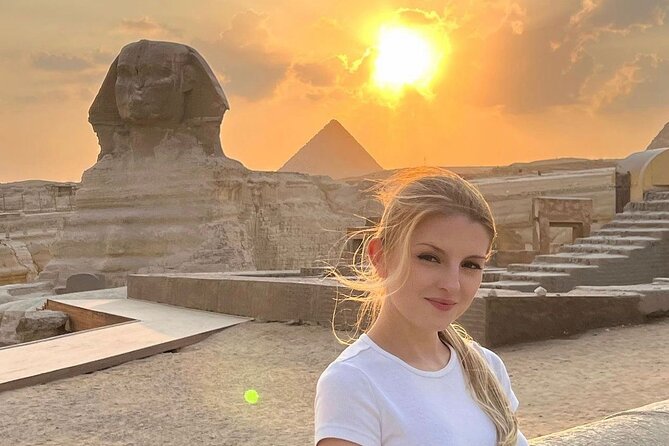
The tour also includes the Valley Temple, where the king’s body was prepared for burial, and the Great Sphinx. The Sphinx is linked here to the reign of Chephren, around 2550 BC, and is described as the oldest and largest sphinx in ancient Egypt.
You have about two hours at Giza. That is a sensible amount for an overview, photographs, the Sphinx, and a clear explanation of the site. It is not enough for a slow, independent exploration of every viewpoint or for lingering at each pyramid. If you want to enter one of the pyramids, ask about the separate ticket arrangements before the day begins.
Lunch follows at a local restaurant, and the vehicle returns you to your hotel afterward. Since lunch is included every day, you do not have to spend part of the sightseeing day sorting out where to eat.
The Egyptian Museum and Cairo’s older faiths
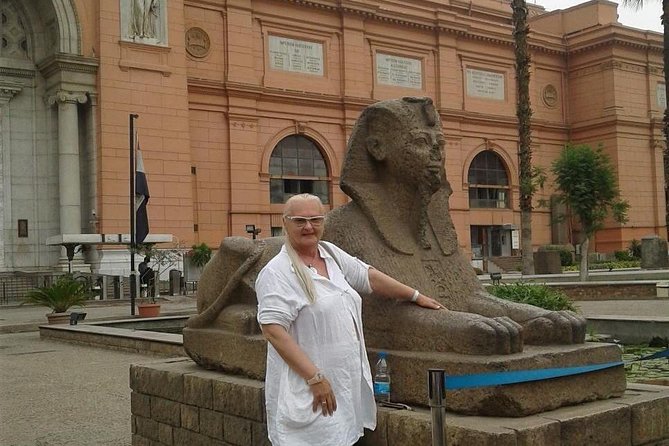
Day 2 shifts from the Old Kingdom to Cairo’s museums, churches, synagogue, and Islamic monuments. The first stop is the Egyptian Museum, with about two hours inside.
The listed areas include the Animal Mummy Room, mummy portraits, and King Tutankhamen’s jewelry. These highlights give you several different ways to read ancient Egyptian culture: animals connected with religious practice, painted portraits linked to later periods, and royal objects associated with one of Egypt’s best-known pharaohs.
Two hours can pass quickly in a museum of this type. I would stay close to the guide for the first part, then ask for a little independent time if the schedule allows. A guide can point out the objects that best fit the day’s story, while you can use any remaining minutes for pieces that catch your eye.
Next comes Coptic Cairo, an important change of pace. The route includes the Roman Fortress of Babylon, the Hanging Church, the Church of Abu Serga, Saint George Church, and the Ben Ezra Synagogue. You’ll also visit the cave associated with the Holy Family’s shelter during its time in Cairo.
The value here is the concentration of different religious traditions in one small area. You are not looking only at ancient pharaonic monuments. You are seeing Roman, Christian, and Jewish layers of Cairo, with a guide to explain how the sites fit into the city’s long story.
The church interiors and religious sites call for respectful clothing and behavior. The supplied information does not list a formal dress code, but covering shoulders and knees is a sensible choice for this part of the day.
A different kind of day out, same part of Egypt:
- Tour to Giza Pyramids and The Egyptian Museum
★ 5.0 · 6,016 reviews - VIP All inclusive Best of the best Giza Pyramids,Sakkara,Memphis
★ 5.0 · 3,164 reviews - From Cairo: Pyramids of Giza, Sphinx, Saqqara & Memphis Tour
★ 4.7 · 3,110 reviews - Cairo: Pyramids, Sakkara & Memphis Tour with Lunch
★ 4.6 · 2,493 reviews
Saladin’s Citadel and Mohammed Ali Mosque
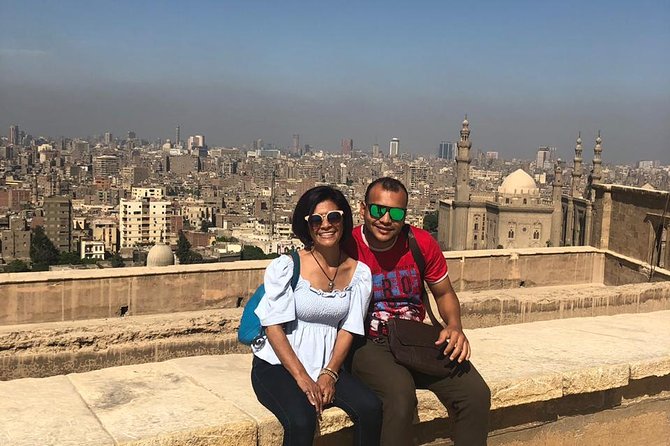
The Citadel of Saladin gives you a broad view over Cairo and a short break from enclosed museum and church spaces. You have about one hour here, including time for photographs and a visit to the Mosque of Mohammed Ali Pasha.
Built in 1848, the mosque is known for its large size and high position inside the Citadel. The tour explains its resemblance to Hagia Sophia in Istanbul, giving you a useful way to understand the building’s Ottoman influence.
The Citadel stop is more than a photo opportunity, though the panorama is a clear highlight. It helps you see how Cairo’s monuments and dense urban areas fit together. Your guide can also connect the Citadel to Saladin and the later history of the city.
One hour is enough for the main mosque and the view, but not for a slow examination of every part of the complex. Keep your footwear and clothing in mind for mosque entry, and listen for any instructions from the guide.
Khan Al-Khalili after the monuments
The final Cairo stop is Khan Al-Khalili, the city’s best-known market district. It was founded during the Mamluk period in the 14th century, when Sultan Barquq granted the land to his friend Jahrkas Al-Khalili. The market was built on the site of a Fatimid cemetery, a detail that shows how Cairo repeatedly rebuilt itself over earlier layers.
You have about two hours to walk through the market. This is the least structured part of the Cairo itinerary, so use it to browse, take in the lanes, and practice polite bargaining if you decide to shop.
A guide can help you get oriented and may make the market feel easier to approach, especially if Cairo is new to you. Still, keep an eye on your belongings and agree on any purchase price before accepting an item. The tour returns you to your hotel at the end of the day.
Flying to Luxor for a full day of temples and tombs
Day 3 is the most ambitious part of the trip. A driver picks you up at your hotel and takes you to the airport. After flying to Luxor, a local guide meets you and leads you through the main sights before returning you to the airport for the flight back to Cairo.
The schedule is listed at approximately 12 hours, so this is not a leisurely Luxor visit. It is a way to add Luxor when you do not have enough time for an overnight stay.
Karnak Temple comes first. The complex includes the Temple of Amon, the Great Hypostyle Hall, and the Avenue of Sphinxes. Give yourself time to look up and across the columns. A guide’s explanation is especially useful here because the scale can make individual buildings and religious purposes hard to separate.
The route then crosses to the west bank for the Temple of Queen Hatshepsut, also called Deir el-Bahari, and the Valley of the Kings. Hatshepsut’s temple is built against the cliffs, while the Valley of the Kings focuses on royal tombs rather than above-ground pyramids.
The number of tombs open can change, and the information supplied does not specify which individual tombs are included. Ask your guide what is open that day and whether any extra ticket applies if a particular tomb is important to you.
The itinerary continues to Luxor Temple and the two Colossi of Memnon. Luxor Temple is especially useful as a contrast to Karnak because the sites are connected but not identical in purpose or scale. The Colossi make a quick but memorable stop, and lunch is included before the return to Luxor airport.
The Luxor segment is listed with no admission charge, while the package also lists entrance fees as included. I would confirm the precise ticket coverage for each Luxor site when booking, especially if you want access to specific tombs.
What the $1,000 price really covers
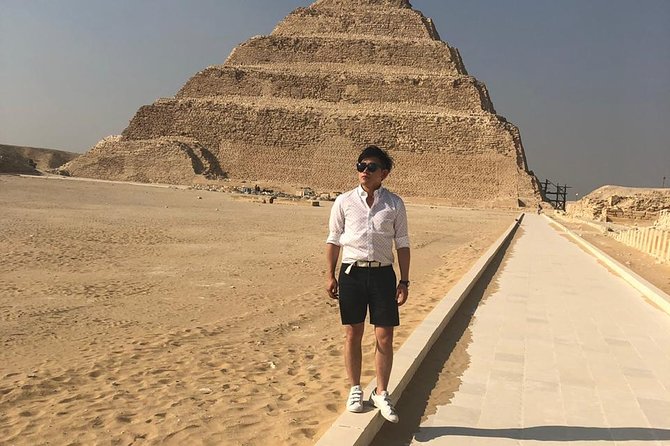
At $1,000 per person, this is not a budget sightseeing package. The value depends on what you would otherwise spend arranging privately: a guide, a vehicle, entrance tickets, three lunches, snacks, airport transfers, and return flights to Luxor.
The private format matters most. Only your group participates, so you avoid joining a large coach group and can ask for explanations at your level. It should also make hotel pickup and drop-off simpler, since the company handles the movement between sites and airports.
Accommodation is not included. You need to book your Cairo hotel separately, and the information provided does not say whether a Luxor hotel is needed, since the plan returns to Cairo the same day.
Group discounts are offered, so the price may work better for couples, families, or small groups than for a solo visitor. Ask for the current group rate and confirm all flight and ticket details before paying.
How the guides shape the experience
This itinerary contains many names, dates, rulers, religious traditions, and architectural terms. A guide who explains clearly can turn a tiring list of stops into a connected story.
Hala, also known as Sugar Queen, is associated with energetic and engaging tours and is especially useful if you prefer explanations with simple visual aids. Muhammad and Muhammad Raki are also names connected with the company’s guiding team. Dr. Mo and Mark have been associated with ancient Egyptian explanations and Luxor visits.
You cannot assume you will receive a particular guide unless the company confirms it. If you have a preference, request that person at booking, but treat it as a request rather than a guarantee.
Who should book this three-day plan?
I would choose this tour if you have only a short stay in Egypt and want the major Cairo and Luxor highlights without organizing several separate services. It fits first-time visitors who value a guide, private transport, and a clear route.
It also suits families and small groups. Hotel pickup, included meals, and a private vehicle reduce the small decisions that can wear you down in a busy destination.
I would think twice if you prefer slow museum visits, long café breaks, or several nights in Luxor. The plan gives you breadth rather than spare time. Day 3, in particular, asks you to accept a very early start, flights, airports, a full day of monuments, and a return flight.
Free cancellation is available up to 24 hours before the start time for a full refund. Changes or cancellations within 24 hours are not accepted for a refund, and poor weather may lead to a different date or full refund.
Should you book it?
Book this private Cairo and Luxor tour if your priority is seeing a lot in three days with an Egyptologist, included meals, private transport, and flights handled for you. The strongest parts are the thoughtful progression from Dahshur to Saqqara to Giza, the range of Cairo’s religious sights, and the chance to reach Luxor without a long overland journey.
Skip it if you want a relaxed Egyptian holiday or if $1,000 per person feels high once accommodation and any extra tickets are added. For a short, ambitious first visit, though, the plan offers a practical way to cover the country’s biggest ancient sights in a tight window.
FAQ
How long is the tour?
The tour lasts approximately three days.
What time does the tour start?
The stated start time is 7:00 am.
Is the tour private?
Yes. Only your group participates in the activity.
Is hotel pickup included?
Yes. Hotel pickup and drop-off are included.
Is accommodation included?
No. You must arrange and pay for accommodation separately.
Is the Luxor flight included?
Yes. The package includes a Luxor flight ticket.
Are meals included?
Yes. Lunch is included for all three days, and snacks are also included.
Which pyramids are visited?
The tour visits the Red Pyramid and Bent Pyramid at Dahshur, the Step Pyramid complex and other pyramids at Saqqara, and the pyramids of Cheops, Chephren, and Mycerinus at Giza.
What does the Luxor day include?
The Luxor visit includes Karnak Temple, Queen Hatshepsut’s temple, the Valley of the Kings, Luxor Temple, and the two statues of Memnon.
Can I cancel for a full refund?
Yes. You can cancel at least 24 hours before the experience start time for a full refund. Cancellations within 24 hours are not refunded.
Recently reviewed around Cairo
- White Desert Overnight Camping Sharing Tour in Egypt★ 5.0 · 15 reviews
- Cairo Best 2Days tour Pyramids, Saqqara & Old Cairo★ 5.0 · 15 reviews
- Giza Pyramids with (GEM) Grand Egyptian Museum★ 5.0 · 42 reviews
- Tour to Giza pyramids Memphis Sakkara and Felucca on the Nile★ 5.0 · 16 reviews
- visit the pyramids of Giza + the necropolis of Saqqara + the Memphis site.★ 4.5 · 20 reviews
- sunset at Giza pyramids by camels★ 5.0 · 31 reviews
- Private Giza pyramid,sphinx, Mummification temple& inside pyramid★ 5.0 · 32 reviews
- Private guided shopping tour in Khan el-Khalili with Lunch★ 4.5 · 21 reviews
Cairo Tours, compared.
Pyramids & Great Sphinx Private Tour with Camel Ride
Read our review →
Tour to Giza Pyramids and The Egyptian Museum
Read our review →
VIP All inclusive Best of the best Giza Pyramids,Sakkara,Memphis
Read our review →
Pyramids of Giza, Sphinx, Saqqara & Memphis Tour
Read our review →
Cairo 8 Hour Private Tour of Pyramids, Egyptian Museum and Bazaar
Read our review →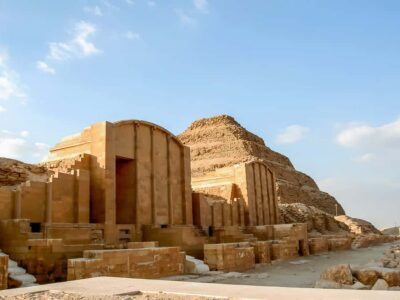
Private ViP all-inclusive Giza Pyramids,Sphinx,Inside Pyramid
Read our review →