
Reviewed · TRAIN EXPERIENCES
Cairo : Luxor East and West Banks Tour by Overnight Sitting Train Rounded trip
Luxor packs some of Egypt’s greatest ancient sites into one long day. This three-day Cairo to Luxor trip uses an overnight first-class seated train in both directions, giving you a low-cost way to reach Upper Egypt without paying for a hotel in Luxor. On arrival, a guide and air-conditioned vehicle take you to the Valley of the Kings, Hatshepsut’s temple, Karnak, Luxor Temple, and the Colossi of Memnon.
I like two things here: the small maximum group of 15 keeps the day more manageable, and the guide handles the awkward transfers between Cairo, the train station, Luxor, and the monuments. The main drawback is the schedule. You spend about nine hours on a seated night train each way, then tackle a full day of sightseeing, and entrance fees are extra.
In This Review
- Key points to know before booking
- What the three-day Cairo to Luxor trip is really like
- The overnight train from Cairo to Luxor
- Starting on Luxor’s West Bank
- Valley of the Kings
- Temple of Hatshepsut at Deir el Bahari
- Colossi of Memnon
- Crossing to Karnak on the East Bank
- Ending the day at Luxor Temple
- Guide quality and the role of the vehicle
- Is $244 a fair price?
- What to bring and how to prepare
- Who should book this Luxor tour?
- Should you book it?
- FAQ
- How long is the tour?
- Is hotel pickup included in Cairo?
- Are the train tickets included?
- Is the return pickup in Cairo included?
- Are entrance fees included?
- Can I get a student discount?
- Can the train be upgraded to a sleeper?
Key points to know before booking
- First-class seated trains run overnight in both directions, so this is practical but not a sleeping-train experience.
- The West Bank comes first, with the Valley of the Kings, Hatshepsut’s temple, and the Colossi of Memnon.
- The East Bank follows, including the huge Karnak complex and Luxor Temple.
- Entrance fees are not included, and payment is required in Egyptian pounds at each sight.
- A private air-conditioned vehicle and local guide are included for the Luxor sightseeing day.
- The group can include up to 15 people, and the train may sometimes be replaced by a VIP bus at no extra cost.
What the three-day Cairo to Luxor trip is really like
This is a sightseeing sprint built around Egypt’s rail network. You leave Cairo in the evening, reach Luxor in the morning, spend the day visiting major monuments, then return to the station for another overnight seated ride.
That arrangement saves a hotel night and fits Luxor into a short Cairo stay. It also asks a lot from you. You need to be comfortable sitting upright for roughly nine hours, sleeping lightly if at all, and walking through major archaeological sites after the journey.
Pickup is offered from your hotel in Cairo or Giza. From there, a transfer takes you to the Cairo train station for the first-class train to Luxor. The included service covers the station transfers, train tickets, vehicle, guide, taxes, parking, and landing fees.
The train is described as first-class VIP seating, not a sleeper carriage. You may find the overnight ride perfectly acceptable if you can rest in a seat, but you should not book this expecting a private bed or a quiet hotel-style night.
More Cairo trips worth a second look
The overnight train from Cairo to Luxor
The train is the backbone of the trip, and it deserves an honest look. A first-class seated ticket gives you a more comfortable category than basic rail travel, but the journey still lasts about nine hours.
I like the train option because it keeps the cost below a conventional flight and avoids paying for a separate hotel in Luxor. You also get a direct sense of the distance between Cairo and Upper Egypt, rather than treating Luxor as just another quick stop.
The tradeoff is rest. You will arrive in Luxor in the morning and begin sightseeing soon after meeting the guide at the station. If you sleep poorly on trains, the first day can feel demanding, especially once the sun and ancient stone sites add heat to the schedule.
The operator may change the seated train to a VIP bus in special cases, with no extra charge. That gives the company some flexibility, but it also means the exact transport plan can change. A sleeper-train upgrade is available for $150 per person round trip, which may be worth considering if sleep matters more to you than keeping the price down.
Starting on Luxor’s West Bank
After meeting the licensed guide at Luxor train station, you travel by private air-conditioned vehicle to the West Bank. This side of the Nile is where ancient royal tombs and mortuary temples take center stage.
The vehicle matters here. You are not left to arrange separate taxis between several sites, and the air conditioning gives you a useful break between outdoor visits. The day remains busy, but the transfers are organized for you.
Valley of the Kings
The Valley of the Kings is the first major stop, with about two hours planned for the visit. This is the burial ground associated with rulers including Thutmose I, Thutmose III, Tutankhamun, Ramesses VI, Merenptah, and Amenhotep II.
The appeal is not just the names. You enter a dry valley cut into the hills, then descend into selected tombs where painted walls and burial decoration survive below ground. The experience is close and enclosed, not a grand outdoor temple visit, so comfortable walking shoes and water are sensible.
Entrance is not included. The exact tomb access can depend on the ticket arrangement and local conditions, so ask your guide what your admission covers before you start exploring. If seeing Tutankhamun’s tomb is important to you, ask directly about the separate admission and availability rather than assuming it is part of the standard ticket.
The Valley of the Kings is also the place where the schedule can feel tight. Two hours sounds generous, but you may need to account for walking between the entrance area and tombs, time underground, and pauses to listen to explanations.
A different kind of day out, same part of Egypt:
- Cairo: Pyramids & Great Sphinx Private Tour with Camel Ride
★ 4.9 · 6,335 reviews - Tour to Giza Pyramids and The Egyptian Museum
★ 5.0 · 6,016 reviews - VIP All inclusive Best of the best Giza Pyramids,Sakkara,Memphis
★ 5.0 · 3,164 reviews - From Cairo: Pyramids of Giza, Sphinx, Saqqara & Memphis Tour
★ 4.7 · 3,110 reviews
Temple of Hatshepsut at Deir el Bahari
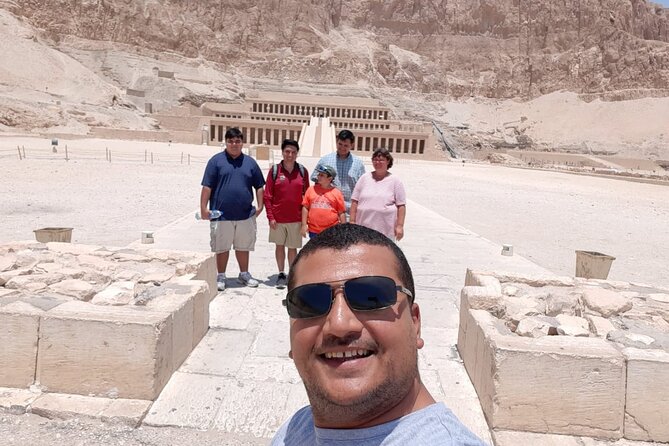
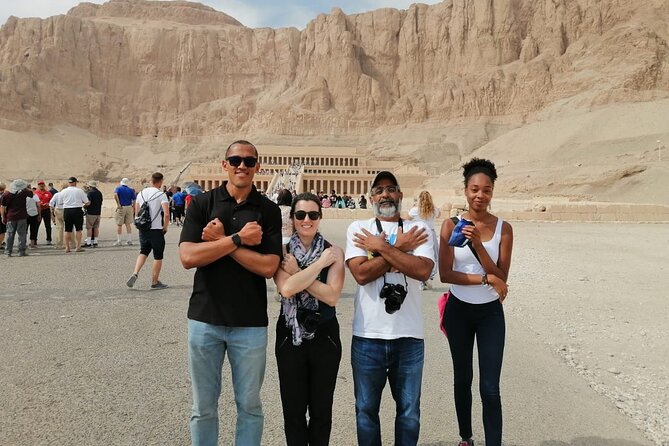
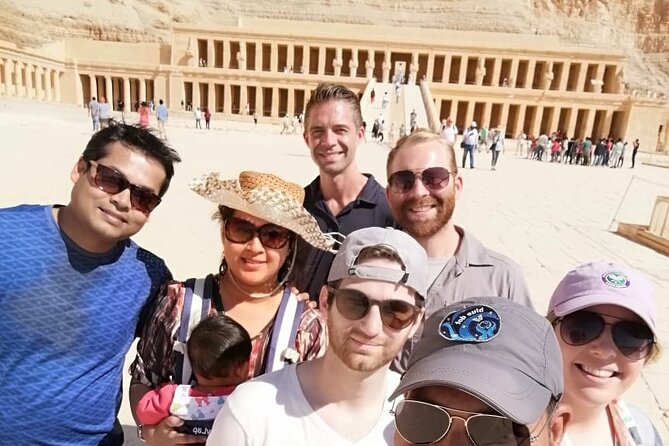
Next comes the Temple of Queen Hatshepsut, with about an hour and a half planned. Hatshepsut ruled as Egypt’s only female pharaoh, and the monument gives your guide a chance to explain how she presented her authority in a culture dominated by male kings.
The temple’s broad terraces and strong lines contrast with the narrow tomb passages at the Valley of the Kings. It is an easier place to understand as a whole because the structure opens toward the cliffs behind it.
You should expect more walking in the open here, and the entrance fee is extra. The guide’s explanation is especially useful at this stop because the site’s importance is political as well as architectural. Without context, it can look like a series of terraces. With context, the building becomes a carefully planned statement of royal power.
Colossi of Memnon
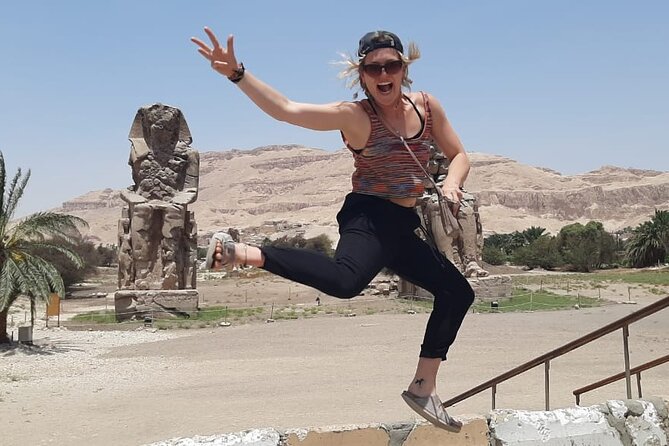
The Colossi of Memnon receive about 40 minutes. These two enormous statues once formed part of the mortuary temple of Amenhotep III, although the temple complex itself is no longer intact in the same way as Karnak or Luxor Temple.
This is the shortest stop, and it works well as a quick photo and orientation break. The admission is free, so there is no extra ticket to budget for here. Do not expect a long guided visit. The statues are impressive because of their scale, but the stop is brief and open-air.
Crossing to Karnak on the East Bank
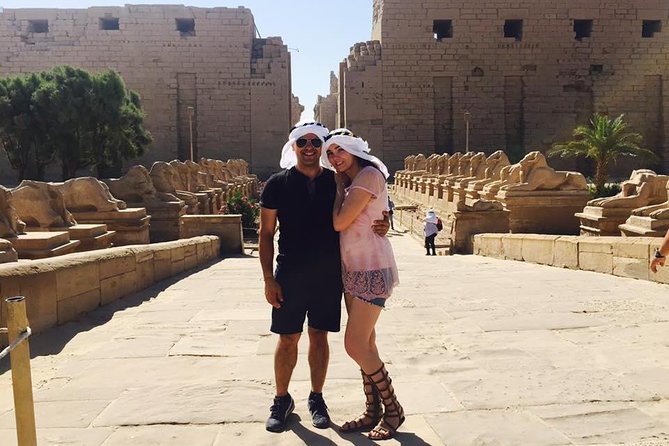
After the West Bank, the vehicle crosses to the East Bank for Karnak Temple. About two hours are scheduled, and that is enough for a strong first look, though not enough to inspect every corner of a complex covering nearly one mile by two miles and containing more than 20 temples.
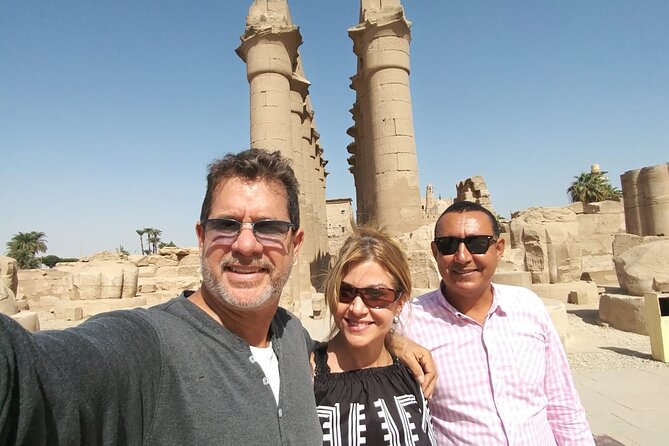
Karnak was dedicated first to Amun-Ra, his wife Mut, and their son Khonsu. Later rulers added their own buildings, columns, statues, and inscriptions. The result is less a single temple than a vast religious center built over many generations.
The Hypostyle Hall is the visual high point for many people. Its huge columns create a forest of stone, and the scale helps explain why Karnak is one of Egypt’s most important architectural sites. The guide can point out how the papyrus-shaped columns and other design choices fit the religious ideas of ancient Egypt.
Entrance is not included, so keep Egyptian pounds ready. The site is broad, and you will spend much of the visit on foot. I would pay close attention to the guide’s route and meeting points because large temple compounds can make it easy to lose your bearings.
Karnak rewards curiosity, but it can also overwhelm you. There are too many columns, statues, courtyards, and inscriptions to absorb in a single pass. The value of a guided visit is that you get a clear route and a sense of what deserves your attention first.
Ending the day at Luxor Temple
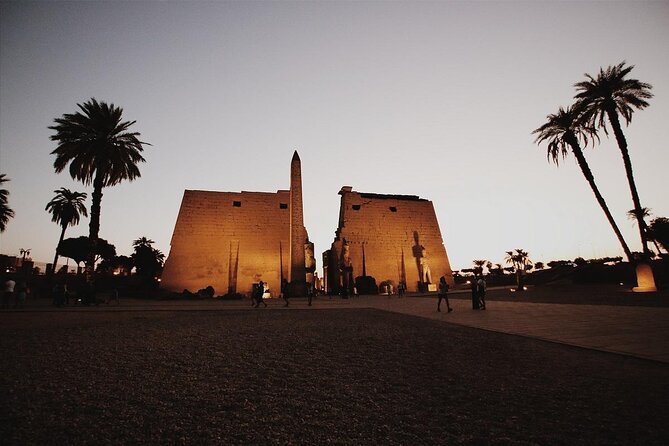
Luxor Temple follows Karnak, with about an hour and a half scheduled. The two sites work well together. Karnak shows the scale of a major religious complex, while Luxor Temple feels more focused and easier to read as one monumental composition.
The temple was linked to the worship of Amun and connected with royal ceremonies. Its location on the East Bank also makes it a fitting final major stop before returning to the railway station.
Entrance fees are extra here as well. By this point, fatigue may be the biggest issue. You will already have visited three West Bank sites and Karnak, so the final temple may require a little extra effort. Still, the contrast between the sites makes the long day worthwhile, especially if you want the broadest possible introduction to Luxor in limited time.
The schedule does not include a separate overnight stay in Luxor. At the end of the visit, you are taken to the station for the return seated train to Cairo.
Guide quality and the role of the vehicle
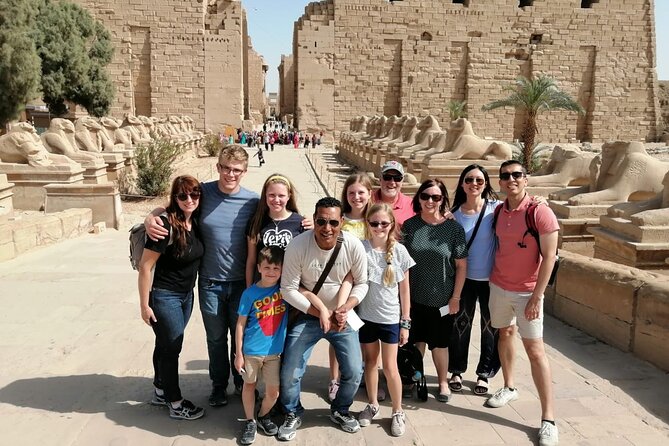
The guide can make or break a concentrated archaeological day. The tour includes an expert guide, with different language options available, and the guide meets you at Luxor train station rather than leaving you to find the sites alone.
Khalad el Sassy is one guide associated with especially strong praise for his explanations and personal manner. You cannot assume he will be assigned to your departure, but you can ask the operator whether he is available.
The private air-conditioned vehicle is another major practical benefit. Luxor’s sites are spread across both sides of the Nile, and arranging transport independently would add time and uncertainty. Here, the driver and guide coordinate the route, while you focus on the monuments.
The maximum group size is 15. That is not a private tour for one couple or family, but it is small enough for a guide to explain details without addressing a huge crowd. Group discounts are offered, so the price may work better for families or friends booking together.
Is $244 a fair price?
The stated price is $244 per person. That includes the Cairo and Luxor station transfers, first-class seated train tickets in both directions, Luxor transport, guide service, taxes, parking, and related landing fees.
It does not include entrance fees to the Valley of the Kings, Hatshepsut’s temple, Karnak, or Luxor Temple. Those costs are paid at the sights in Egyptian pounds. Your international student card gives a 50 percent discount on sightseeing entrance fees, so bring it if you qualify.
The value depends on how much you want to organize yourself. The train ticket alone is not the whole product. You are also paying for two long-distance transfers, a full day of vehicle transport in Luxor, station pickups, a guide, and a structured route through the East and West Banks.
Still, the price is not automatically a bargain. The seated overnight train is basic compared with a sleeper, and admission costs come on top. I would choose this package for convenience and time savings, not because every included item is expensive on its own.
If you are comfortable arranging rail tickets, station transfers, and a private vehicle independently, you may find a self-planned trip cheaper. If you have only a few days in Egypt and want someone else to coordinate the complicated parts, the package has a clearer advantage.
What to bring and how to prepare
Bring your camera, as requested, but prepare for more than photographs. You will want water, comfortable shoes, and clothing suitable for walking through open archaeological sites and underground tombs.
Keep Egyptian pounds available for entrance fees. The operator specifically requires sightseeing fees to be paid on site in Egyptian currency, so do not rely on the $244 price to cover every admission.
An international student card is worth carrying because it can reduce all sightseeing entrance fees by 50 percent. Children must be accompanied by an adult, and most people can participate in the activity.
The return to Cairo ends at the train station. There is no included pickup from Cairo station after arrival, though a pickup can be requested for an extra cost. Arrange your onward transport before boarding the return train so you are not sorting this out while tired.
Who should book this Luxor tour?
I would recommend this trip to you if your Egypt plans center on Cairo but you still want to see the major Luxor sites. It is especially useful for a short visit, since the overnight schedule saves daytime hours and removes the need to arrange a separate hotel.
It suits people who prefer a guide, included ground transport, and a fixed plan. It also works for groups that can benefit from the available discount and the maximum 15-person size.
I would hesitate if you need a full night’s sleep, dislike rigid schedules, or want time for smaller Luxor sights. This plan focuses on the headline monuments and covers them quickly. It does not offer a relaxed multi-day stay in Upper Egypt.
Free cancellation is available if you cancel at least 24 hours before the start time. Cancellations or changes made inside that 24-hour window are not refunded or accepted, and the operator requires a minimum number of people for the trip to run.
Should you book it?
Book this Cairo to Luxor tour if your priority is seeing the Valley of the Kings, Hatshepsut, Karnak, Luxor Temple, and the Colossi of Memnon without arranging every transfer yourself. The guide, air-conditioned vehicle, station pickups, and compact group are the strongest reasons to choose it.
Think twice if you are paying $244 mainly for a comfortable train ride. This is a first-class seated overnight journey, not a sleeper, and admission fees are still extra. For a short Cairo stay, the time saved may justify the cost. For a slower Egypt itinerary, staying in Luxor and exploring at an easier pace would likely be more satisfying.
FAQ
How long is the tour?
The experience lasts approximately three days. The first and second nights involve about nine-hour overnight train journeys, with sightseeing in Luxor during the day between them.
Is hotel pickup included in Cairo?
Yes. Pickup is offered from hotels in Cairo or Giza, followed by transfer to the Cairo train station.
Are the train tickets included?
Yes. First-class seated train tickets from Cairo to Luxor and back to Cairo are included.
Is the return pickup in Cairo included?
No. After arriving at Cairo train station, there is no included pickup service. You can request one for an additional cost.
Are entrance fees included?
No. Entrance fees for the sightseeing stops are paid separately at the sites in Egyptian pounds.
Can I get a student discount?
Yes. An international student card provides a 50 percent discount on sightseeing entrance fees in Egypt.
Can the train be upgraded to a sleeper?
Yes. A sleeper-train upgrade is available for an additional $150 per person for the round trip.
Recently reviewed around Cairo
- White Desert Overnight Camping Sharing Tour in Egypt★ 5.0 · 15 reviews
- Cairo Best 2Days tour Pyramids, Saqqara & Old Cairo★ 5.0 · 15 reviews
- Giza Pyramids with (GEM) Grand Egyptian Museum★ 5.0 · 42 reviews
- sunset at Giza pyramids by camels★ 5.0 · 31 reviews
- Tour to Giza pyramids Memphis Sakkara and Felucca on the Nile★ 5.0 · 16 reviews
- visit the pyramids of Giza + the necropolis of Saqqara + the Memphis site.★ 4.5 · 20 reviews
- Private Giza pyramid,sphinx, Mummification temple& inside pyramid★ 5.0 · 32 reviews
- Private guided shopping tour in Khan el-Khalili with Lunch★ 4.5 · 21 reviews
Train Experiences, compared.

6 Days Nile Cruise:Luxor,Aswan,Abu Simbel with Train Tickets from Cairo
Read our review →
Egypt on Budget – 8 Days ( Cairo , Aswan , Nile Cruise – Luxor ) Sleeper Train
Read our review →
Overnight Luxor Tours by train from Cairo with Hot Air Balloon and much more
Read our review →
4 Days Nile Cruise luxor.Aswan.abu simbel with Train Tickets from Cairo
Read our review →
6- Days Aswan , Abu Simbel , Cruise , Luxor & Round Sleeper Train
Read our review →
Luxor East and West Banks Tour & Overnight SLEEPER Train Rounded trip
Read our review →
3-Day Aswan , Nubian Village ,Abu Simbel , Luxor & Train ticket
Read our review →
3-Day Guided tours to Aswan, Abu Simbel and Luxor & Train and Transfers
Read our review →Browse the lists this tour appears in